
Finding Fresh Loads
Understand CargoVans' two-hour visibility window and build a faster routine for finding newly posted freight.
CargoVans is designed around fresh freight. Instead of keeping old loads on the Loadboard indefinitely, CargoVans focuses on recent opportunities so carriers can spend more time looking at freight that is more likely to still be available.
What makes a load fresh?
CargoVans keeps loads visible on the Loadboard for up to two hours. After that window, the load is removed from the Loadboard. This keeps the board focused on relatively recent freight rather than building up a long list of opportunities that may already be gone.
Why speed matters
Freight can move surprisingly quickly. In practice, many loads may be booked within the first 15-30 minutes after they become available. This is common enough that carriers should treat a newly posted load as an opportunity worth evaluating promptly, rather than assuming it will still be there later.
The 15-30 minute timeframe is a practical observation, not a booking guarantee. Some loads may remain available longer, while others may be gone much sooner depending on the broker, lane, rate, timing, and current demand.
Freshness matters
A recently posted load is generally more likely to still be relevant than an older opportunity. Start with the newest results before spending time deeper in the list.
Act when it fits
When a load matches your vehicle, location, timing, and operating plan, evaluate it promptly. Waiting too long can mean the opportunity is no longer available.
Availability changes
A load can disappear because it was booked, removed, or passed its visibility window. The Loadboard should be treated as a live search environment.
Fresh does not mean profitable
A newly posted load is not automatically a good load. You still need to review the rate, distance, deadhead, timing, destination, and overall trip before making an offer.
Start with the newest opportunities
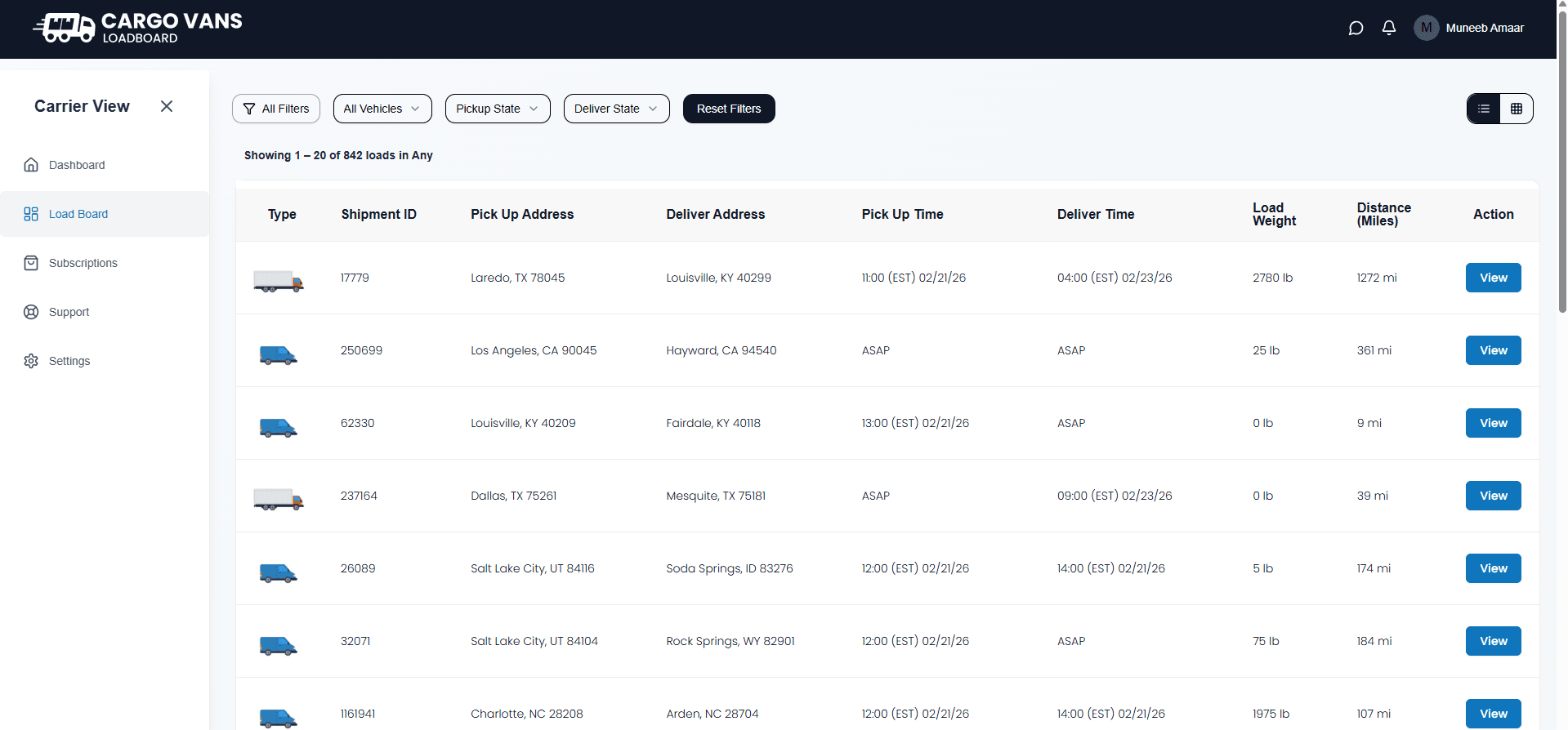
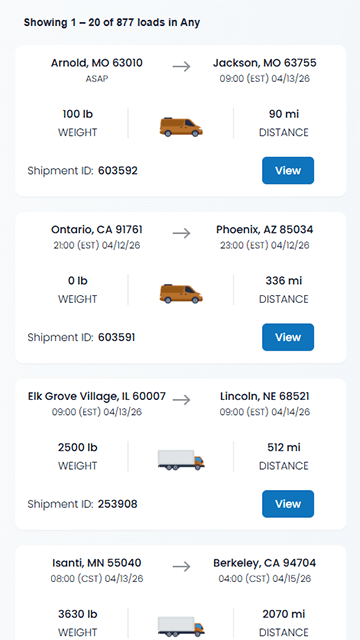
CargoVans displays loads newest first. This gives you a natural starting point whenever you open the Loadboard: begin near the top, scan the newest opportunities, and work downward only when the current results do not provide a suitable option.
Use filters without slowing yourself down
Filters become especially valuable when the Loadboard contains a large number of recent loads. Instead of manually reviewing opportunities that cannot work for your operation, narrow the results to the freight you can realistically pursue.
- Choose the vehicle type that matches your equipment.
- Use Pickup State when you need freight originating in a particular area.
- Use Deliver State when you are targeting a specific destination or market.
- Review the filtered results starting with the newest opportunities.
- Open promising loads and evaluate the complete trip.
Load volume can change dramatically
The number of loads you see on CargoVans is not fixed. Because the platform focuses on recent freight, the visible number of opportunities changes as new loads arrive and older loads leave the two-hour window.
Busy periods
You may see thousands of available loads when freight activity is high. A large board gives you more choice, but it also makes filtering more important.
Quieter periods
At other times, the board may contain only a few hundred loads. A smaller result set does not necessarily mean something is wrong; freight activity naturally changes.
New loads arrive
The board can change while you are working. Returning to the Loadboard later may reveal opportunities that were not available during your previous search.
Older loads leave
Loads age out of the two-hour visibility window and are removed. This is why the board should be treated as a changing pool of recent opportunities.
Build a repeatable fresh-load routine
If you are actively looking for your next load, checking CargoVans once and leaving it open for hours is not the best approach. Build short, repeatable checks into your routine so you have more chances to see newly posted freight.
1
Scan
Start with the newest opportunities rather than searching randomly through the board.
01
Open the Loadboard
Begin at the top of the current results where the newest loads are displayed.
02
Look for obvious matches
Quickly identify loads that appear to fit your vehicle, pickup area, destination preferences, and timing.
2
Narrow
Reduce the result set when the board contains more opportunities than you can realistically review.
01
Apply your filters
Use vehicle, pickup-state, and delivery-state filters to focus on freight that makes sense for your operation.
02
Keep the newest results first
After filtering, continue from the newest matching opportunities rather than treating every result as equally timely.
3
Act
Move quickly once you find something worth pursuing.
01
Open the load
Use View to inspect the full Load Information before deciding whether to make an offer.
02
Evaluate before committing
Freshness is only one factor. Review the complete trip and make sure the opportunity actually fits your operation.
Stop Watching, Start Getting Notified
We're working on a new way to help carriers catch the freight that matters to them. Soon, you'll be able to tell CargoVans which states and routes you want to watch, and we'll notify you when matching fresh freight becomes available.
📍
Watch your preferred states
⇄
Watch your preferred routes
🔔
+
✉️
When matching freight appears, you'll receive a CargoVans notification and an email so you can return to the Loadboard and evaluate the opportunity.
Fresh does not mean you should rush blindly
Speed is important, but speed without evaluation can lead to poor decisions. The goal is not to make an offer on the first fresh load you see. The goal is to recognize suitable opportunities quickly and evaluate them efficiently before acting.
Does the vehicle requirement match your equipment?
Can you realistically make the pickup?
Does the delivery location fit your operating plan?
Is the timing workable?
Does the distance make sense for the trip?
Have you considered potential deadhead?
Does the rate make sense for the complete trip?
When there are thousands of loads
A large Loadboard can feel overwhelming if you try to review every opportunity. Start with the newest results, apply the filters that matter most to your operation, and eliminate obvious mismatches quickly. Your objective is to create a manageable list of loads worth opening rather than reading every row or card.
When there are only a few hundred loads
A smaller board gives you an opportunity to scan more broadly. You can still start with your strongest vehicle and geographic preferences, but it may be worth looking beyond your usual filters when your immediate options are limited.
Your fresh load habit
- Check CargoVans when you are ready to look for freight.
- Start with the newest available loads.
- Filter quickly when the result set is large.
- Open the strongest candidates.
- Evaluate the complete trip before making an offer.
- Return to the Loadboard periodically while you are still looking.
Next: Evaluate the opportunity
Finding a fresh load is only the beginning. Once you spot an opportunity, the next step is deciding whether it is actually worth pursuing. That means looking beyond freshness and evaluating the complete trip.